Labor Repose
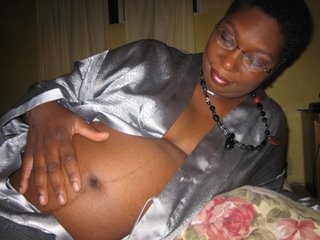
LaborPayne during her 6th homebirth (9th baby) at age 44
Monday, October 4, 2010
Day 5- Operation Haiti
Just when I think I've seen the most poverty possible... When we went out to clinic today, we went to another remote area waaaay off the beaten path, in fact it was off any real road. We jumped into our rented tap-tap (a taxi truck with benches in the back that we ride on) with our suitcase pharmacy and headed down the paved highway, then turned off onto a cobblestone street, then onto a mud road. The road (and I use the term loosely) led us through a low lying area that must be flooded ankle deep a good part of the year, as it was today, and yet people were living there. Walking around in the ankle deep muck and carrying on their daily business. The houses were mere shacks and more pieced together tents. I couldn't imagine living under such conditions. Water from an overflowing river mixed with what ever was in the open sewers and all was carried along in a constant stream of fluid slush. The people don't drink the water but they do use it routinely for both bathing and toileting. This is a natural breeding ground for disease. We kept driving to a point where the road literally led into the river. We stopped on the side and watched as vehicles just drove right across the quickly rising river and as one enterprising entrepreneur made a quick business of carrying people back and forth from one side to another on his back. People would drop small coins into his and and then leap on his back as he shuttled them across. Others would just remove their shoes, hike up their pants or skirt, and move briskly through the swirling rising brown water. Our driver contemplated for a few minutes if his tap-tap would make it, and we contemplated if we would be safer riding across the river or walking! I thought about paying that guy to carry me! (He would have charged me double!) Finally we all got into the tap-tap, said a quick prayer, and whoosh, down a steep embankment, across the river and up a second steep embankment where the road continued on undisturbed. Undisturbed for a mud road full of deep pits (the term pothole does not apply here). Drivers in vehicles, motorcycles, bicycles, horses, ox drawn carts (whatever!) zoom quickly from one side of the road to the other avoiding the million pedestrians also crowding the road as well as the mud and water filled pits and the other drivers. Whew. I get tired just recalling that drive. The mud road continued on leading us to a little village I have dubbed, "scabiesville" (since almost every child I saw today had track marks on their arms and legs where the little critters burrow under the skin). This was the most impoverished place I've been to date. How they eek out a living in this remote mud encrusted place I don't know. As at home, rural poverty trumps city poverty, and it broke my heart to see children living this way. We set up our clinic in a 'church' really just a tin roof over a concrete slab with open sides and lots of wooden benches in it. As they came through my triage station, I made them 'balloons' from my latex gloves. Word must have got out because soon even children who weren't being seen came to the entrance of the church and looked at me slyly until I blew up a glove for them. Again, we saw lots of sick babies with fevers and lots of elderly with sky high blood pressures. I saw one elderly woman with a blood pressure of 240/120. It would not go down after even two doses of antihypertensives (prolanolol). She hobbled away with her baggie of medication after being told to return in two weeks when the clinic returns. We finished quickly seeing everyone amid reports that the river was rising. Not wanting to be stranded in scabiesville, we packed up and headed once more across that river pretending to be a road. Sure enouygh the river was moving faster and the trip back across was even worse! George, our interpreter thought it great fun and wanted to do it again. George, I said, do you want to drown me in the river, or have me float out to sea? We arrived back home safe and sound with the most exciting thing about today being the drive to and from the clinic. My colleagues are out seeking adventures but I am content to nap after our return and journal, and waiting for what I'm sure will be another delicious Haitian meal.

Day 4- Operation Haiti
Today, my four colleagues went out to do a community clinic, while I stayed at the clinic in the can, just down the road a few feet. It was a routine, uneventful clinic with the Haitian doctor. We saw about 30 patients, mostly sick babies, and elderly with chronic conditions. There is so little we can to about the chronic conditions, but because the clinic in a can (a trailer building, built in China and 'mailed' here to it's current location), is more/less permanent, folks can come back to get refills on their high blood pressure medication (lots of hypertension and heart disease). Today was a very eventful day, however, not because of the clinic. We finished up around 1:00 and I headed home to the maternity clinic for lunch. Soon after, my peers returned from their clinic as well, and we also decided to take a walk with our interpreters, George and Mose. George and Mose are 21/22 years old, the typical age of interpreters, young, strong, handsome, and outgoing. As we walked, nurse Linda told me about her most challenging case of the day:
Linda saw a pretty, petite Haitian young woman of about 20 years of age. She administered a pregnancy test to the girl and it was positive. When she found out she was pregnant, she became upset because her parepnts would be angry with her. She said that she would seek an abortion. When Linda tried to talk to her about it, she would not be dissuaded. Even the interpreter told her the girl was determined to do it. Linda gave her birth control information and discussed other options, but in the end gave her a course of antibiotics and made her promise to take them after the procedure was done. Hearing this story was heartbreaking, and Linda was obviously still shaken by the encounter. I'm so glad Linda thought to give her antibiotics. The greatests risks with abortion are hemorrhage (which will kill you quickly) and infection (which will kill you slowly). In a country like Haiti that is very undeveloped and very Catholic, I think she will have a hard time finding a safe practitioner to give her an abortion. Most hospitals are owned by religious organizations which won't offer them. She told Linda she would do it herself if she had to, by pills or by 'other means'. I teach about abortion as a part of my OB lecture so depending on how far along in her pregnancy, pills won't do the job after between 9-12 weeks gestation. If she uses an instrument on herself she is at very high risk of hemorrhage or infection or both. In other words, there are no good forseeable outcomes for this young woman. Attempting an abortion could very well be a death sentence for her. A very sobering thought indeed. Tomorrow I'll ask Dr. Denton (our host) about this. I'd like to know the frequency of abortion here and what options she has to get it done safely.
As our walk continued,we wound our way around the 'neighborhood'. It was quite unlike the view from the road in a tap tap. As we walked we saw up close and personal how people lived. Even after a previous trip to Haiti, I found it shocking. People living in tents and shacks along side their cattle, goats, and pigs. How they lived this way was inconceivable to me. No electricity, no running water. I felt as if I were seeing the real Haiti for the first time. All the people came out of their houses to see the 'Blancs' walking by. No doubt very few whites/westerners ever see what we saw. George and Mose greated all their neighbors graciously and if I smiled and said "Bonsua" they smiled and said it right back, We passed lots of new wooden small shacks that various organizations had come in and built, they were tiny little houses but far superior to a pieced together tent. George took us to his home to meet his family which included a grandmother, a cousin and her three children and another cousin, sister to the first. George's mother died when he was young, and he lost his father in the earthquake. George and his cousins and grandmother lived in a tent outside their home which had sustained lots of earthquake damage and was being repaired by several men walking around and hammering on the roof. 'The men climbed into the trees to get us coconuts, which George's cousin slashed open with a machete and we all drank fresh coconut milk and ate the coconut out with spoons. We stayed about an hour and George and I talked a long time. He wants to go to school in the US and study law and then return to 'do something great for Haiti'. I believe that someday, George will do just that.
We had other adventures on the walk, including seeing an abandoned sugar cane factory, that George says will open in October and employ 2,000 Haitians (may it be so). I lost a flip flop during the walk, and could not continue, so George hired a motorcycle to drive me the rest of the way back to the clinic. I was very nervous, (folks use motorcycles for taxies here, and it was not unusually to see four or five people on a bike zooming by in one direction or another) but as I was the only rider on a privately rented bike, and Mose did the driving (the driver stayed behind with our group) and he headed my admonishments to 'GO SLOWLY MOES" it went pretty well. Remember there were no paved roads where we were, only dirt and rock streets (that's why my flip flop didn't hold up) and of course full of huge holes! So there was Mose driving slowly with me on the back, while he weaved in and out of traffic and gigantic pot holes. That was my adventure for the day. I got back in time to wolf down dinner (a potato, carrot, and greens stew, flavored with meet of an unknown origin, and served with (you'll never guess) beans and rice. All delicious. Then I accompanied Dr. Denton to the hospital to visit a post op patient, which I will write about tomorrow.
Day 3- Operation Haiti
Today saw another early start, as four of our small group took a short tap-tap ride to the beach and set up a clinic under the palm trees. We saw about 50-60 patients, some we could help and as always, some we could not. After we had seen every patient, my colleagues took a dip in the ocean while I enjoyed the scenery (I'm not a swimmer). We rode back 'home' to our little maternity hospital and I took a nap until dinner. Tonight we were served a potato, yam and beef stew and white rice with a pureed bean sauce. I've since spent 3-4 hours reading homework (I have a pathophysiology test when I return home) and am finishing a long day with my journal. I'm short on detail because I'm tired and in need of sleep, but it has been another amazing and thought provoking day. We had great discussion over dinner processing what we are seeing: the nature of health and wellness, the geopolitial and socio-economic basis for health, the upheaval of Haiti, the nature of family, the meaning of hope and happiness. Sometimes it is all too much to take in at once. Thank goodness for interludes of blessed sleep.
Addendum: Now with some sleep, I'm ready to reflect upon a couple of events yesterday.
Most interesting case: We saw a boy of 12 years yesterday with severe cahexia (not just lack of fat, but lack of muscle- literally skin and bones.) He was with his mother and younger brother and sister all of whom were well nurished and looked fine. His mother stated that he had been sick for two weeks and had no appetite and diarrhea, but his severe state looked like it took a lot longer to produce than two weeks. He was flaccid and lethargic (not surprising- we produce our energy (ATP) in our muscle fiber and he had very little) and had a very flat affect. He was given a referral to the hospital for follow up care. He was heartbreaking to behold, and difficult to even look at. I felt this child might be dying and there was so little we could do. We talked about him long after clinic. We have no diagnostic equipment to diagnose so we can only guess at what the problems are based on clinical manifestations. Did he have severe and prolonged intestinal worms? Was it neonatal transmission of HIV/AIDs? Did some combination of opportunistic infections tax his immune system to the point it wasn't fighting back? Sadly, there is no way to tell. Worse still, no way to tell if his mother took him to the hospital. You need money to pay for healthcare up front. Without money, they'll be turned away, no matter how dire the situation. The hospitals here do turn people away for all kinds of reasons. I can only hope that emaciated boy with the haunting eyes gets the medical attention he so desperately needs.
Day 2- Operation Haiti
Today was our first full day in Haiti. Two of us, Pam and I got the coveted spots to Leogone. Chris, Rebecca, and Jessie remained in Petionville to work in the Port au Prince clinic. I say 'coveted' as tongue in cheek. To get these slots we had to get up at 5am, take a very long 2 hour drive up into the mountains and work in an outdoor clinic in the tropical heat. Pam and I are part of a group of 5 (1 resident, 3 nurses, 1 nursing student) selected to spend the week here in Leogone, a small impoverished mountain town. From Leogone we will visit other villages on other days to do one day clinics. We are hosted by a local Haitian physician that has a small maternity hospital. Dr. Delson and his wife and three small children lived next door to the hospital, but their house was demolished by the earthquake, and now they live in the hospital. The have given us quarters in their hospital. The other four women share a large sunny room with four beds, but I got a private room with an attached bathroom! Quite the luxurious accomodations! We worked in a 'clinic in a can'. This is a trailer buidling delivered here by Heart to Heart. It is airconditioned and has three rooms in it, a pharmacy and two exam rooms. Pam and I triaged patients in the courtyard, while the two docs saw patients in the exam rooms. Everything went very smoothly and it was a great clinic day. Our most interesting case today was a man getting follow up wound care after being in a motorcycle accident two weeks ago. We tentatively romoved his bandages to find great looking granualation tissue- a sure sign of good healing and no signs of infection. Pam and I worked triage today. We did weights and vitals on each patient prior to their seeing one of the doctors. The clinic was well organized and everyone was seen by 1:00. I took an afternoon nap while the others walked to a gas station to buy beer and soda. We were served a delicious dinner of savory stew made with pumpkins, and beef and lots of varieties of beans served over (guess what) beans and rice. It tasted so good, we all had seconds. I plan to spend my evening studying (I have a test the day after I return). Tomorrow our group of five subdivides again while some stay behind to work in the clinic in a can, and the others of us will go further up into the mountains to more remote villages. We have to pack up our pharmacy and take everything with us. If we don't carry it in, we won't have it. I'm eager to learn how things are going for Chris, Rebecca, and Pam back in Petionville. I hope their first day went as well as ours. Looking forward to more of the same tomorrow.
Day 1- Operation Haiti
We made it safe and sound! I can't believe that am once again in Haiti. It all seems so familiar, like another home. After foregoing sleep last night and catching a 6 am flight, we arrived intact after 3 uneventful flights. Our courier met us at the airport and took four suitcases of diapers and pads, and infant clothing. Kicko, my Haitian son, also met us there and I presented him with a refurbished laptop and an I-phone. It was so great to see him. He looked great- maybe a little skinny. Our host was also there to meet us and we all piled into the tap-tap (along with Kicki- we gave him a lift- he lives in Petionville where we happen to be staying). We arrived at a lovely air-conditioned mansion to a lovely dinner made by the Haitian cook. We had a meeting to decide who would go to Leogone in the mountains for the week and who would stay here in Port au Prince and work. Our team was split in half. Pam and I will go into the mountains tomorrow morning. Rebecca and Jessie were dissapointed to be left here (in the air-conditioning) but they will have a busy week here as well. I'm off to bed, very much sleep deprived, and am hoping for internet in the mountains so I can keep up this blog. Haiti is beautiful. Her people are beautiful. I remind us all that we are here to not only give, but to receive- the love of the Haitians, the beauty of the land, and the ceaseless grace of our creator.
Thursday, September 30, 2010
When in Haiti...
I am keeping a blog of my trip to Haiti but blogger won't let me copy it into here, so you must follow my link to Operation Haiti to read it.
Saturday, September 18, 2010
Haitian Donations
Eights days until my return to Haiti. I look forward to seeing Port au Prince again, and also traveling into the mountains to Leogone (the epicenter of the earthquake). I don't know what to expect, so I have no expectations. I know things will not be very different from what I encountered before. Our final team includes two students, one other nursing instructor, a photographer, and myself. We are small but mighty. We will be delivering medical supplies to our hosts (Heart to Heart International), and cloth diapers and cloth sanitary napkins to a courier who will take them to Maisson de Naissance, a birthing center several hours outside of Port au Prince. We also will bring gifts of clothing to an orphanage. If I raise enough funds, I will also take a refurbished laptop to my former interpreter, Kicki, to use as he grows his cyber cafe business. The outpouring of support for this trip has been phenomenal. A group of ladies in central Missouri has hand sewn all the sanitary napkins for us (Thank you Womb Room). The Phi Beta Kappa of Brown Mackie held a fundraiser all of July and purchased 300 cloth diapers for us to donate. We held a big fundraiser party with drummers and dancers and donated Haitian food (thanks Women of the Drum, Lon Lane's Inspired Occasions, and Josie's Sweet Treats) and raised $500. Between our fundraiser events and our individual donation solicitations, we have raised over $4,000 for this trip. We have also made wonderful new friends. Joseph and Glory Idalbert are Haitian Americans who run a local nonprofit to assist their fellow Haitians with adjustment to American life. They offer language classes and job training. We reached out to their organization, Glory House Services, and found our local link to the Haitian community of Kansas City. Joseph and Glory accepted a donation of 3 large crates of infant and children's clothing that we could not carry into Haiti due to the limits of what we could carry. We hope folks will be content to know that even though their donations didn't make it to Haiti, they will benefit Haitians. I also met Captain Jose Belardo of the Public Service Corps. I visited with him before my March trip to Haiti and now he will make a presentation to our group to prepare us for the diseases we will see and how to treat them. It has been an amazing ride, preparing for this trip. I didn't know we would impact so many- and we haven't even left yet. I was asked to prepare a presentation for a meeting of college presidents of all the Brown Mackie Colleges around the country. I made a plea for service learning to be incorporated into all the nursing curriculums. We are planning a joint party with Glory House Services when we return to share our experience and everything we learned. Never could I have imagined that a single thought I had while in Haiti back in March (to bring my nursing students back to Haiti with me) would yield such a response. If you want to keep up with the trip as it happens, visit our website where we post daily at http://www.operationhaiti.webs.com/ It is a fitting present on my 48th birthday today, to reflect back on what has transpired over the past seven months to make this trip happen. I just love to see vision made manifest.
Subscribe to:
Posts (Atom)