Labor Repose

Labor Repose
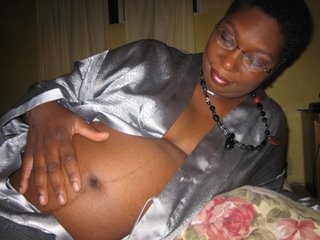
LaborPayne during her 6th homebirth (9th baby) at age 44

Sunday, May 22, 2011

Becoming Haitian


After many mishaps (including a cancelled flight and a 12 hour wait for the next one) I finally arrived in my beloved Ayiti. When I arrived at the airport tired, from a night without sleep (from sitting up in an airport) and being crushed in a small airplane seat for hours, I felt so good to finally touch down. There were my mountains (ever constant!) waiting for me. Dr. Delson and his driver, Francios arrived shortly after I emerged from Toussant L'Ouveture airport into the hot, crowded outdoor waiting area. The hour and a half drive back to Leogone seemed shorter, since I slept through most of it. I thought I might have my old room back again, but Dr. Delson ushered me to my new quarters, a small second floor apartment that was being built the last time I was here. I entered my small neat quarters with an attached bath and saw how hard the Merisiers had worked to secure my comforts. Dr. Delson pointed to a self standing air conditioning unit in the corner of the room. "It doesn't work" he apologized, "not enough electricity to run it." He had purchased two of them and installed the second in his and Mrs. Merisier's bedroom, but without electricity enough to run either. In truth, I was glad. Though the heat was oppressive to some visitors, I handled it well enough. After all, the hot wet heavy air is reminiscent of my midwest home. "Dr. Delson", I assured him, "When I am in Haiti, I will be Haitian."

Upon my arrival, I greeted Madam Merisier and the three children and gave them all gifts. Madam recieved sturdy cooking utensils, the oldest boy of eight I gave a toy airplane, Delshawna, the six year old girl got a purse with a stuffed cat in it, and to four year old Junior, whom everyone affectionately called, Gigi, I presented a pack of tonka trucks. I also handed Monsieur the money for my room and board for the week, which he promptly handed (without counting) to Madam.

On the ride back from the airport, Francios produced a bag of sandwiches. I was hungry, but disappointed to see the bag held a hamburger and fries (the Haitian version of which is far from palatable). I was hoping for some Haitian delicacy. I munched a couple of fries to be polite, and downed a bottle of water instead.

However, after arriving at the clinic (serving as the family temporary home as well), I showered, changed and came down to dinner to a real Haitian meal. Madam Merisier did not dissapoint. She served rice over which was generously poured a rich, succulent bean gravy. This was served alongside a hearty stew of carrots, greens and beef. I can taste it, even as I write. This was the stuff for feeding a weary sojourner. Alongside was served a cherry drink, made from the Merisier's own cherry tree, that was thick and delicious and had the consistancy of a slushy. This theme of consuming what they themselves had grown, or raised and slaughtered was to continue.

After dinner, Monsieur (Dr. Delson) asked if I would like to accompany him on his favorite end of the day activity. The children followed along as we walked a short way up the road to the plot of land where is house once stood. He unlocked and pushed open the gate, and an entire HERD (yes I know chickens come in flocks, but they came at us like a herd!) of chickens came clammoring towards us. Monsier laughed and said, "They know it is time to eat." There must have been about 50 chickens in the yard. A small white chicken even jumped into his arms, not waiting for him to lower the bowl of feed to the ground. Monsier smiled again, "She always does that." I watched as he went patiently about, feeding his chickens and telling me how he had figured out to breed chickens so successfully. He kept the hens with chicks caged at all times, because he found left loose at night, they were killed by 'rats, snakes, and mongooses'. He also discovered that given them medication at certain times of the year kept them from succombing to infectious disease. At night, all the chickens retreated to their pens to be locked in for the night, and the four dogs living on the property, were let loose (as they were penned by day), to discourage theives or mongooses who might try to get at the chickens. There was also a tom and hen turkey among the chickens. Monsier, had hoped for some baby turkeys, but the latest nest had, 'gone bad'. The hen turkey was kept penned so that she would not return to sit on the doomed nest. Monsier grabbed the tom turkey and put him in the pen with the hen, saying, "Now, go to her" betraying some wish that soon there might be a new nest.

Afterwards, we walked to the back of the property to feed the goats. I did not know the property went back so far (the foliage is so heavy) but as we walked, we passed not only the eery tangled metal remains of the Merisier house, but two other houses as well! "Monsier," I asked, whose houses are these?" They belonged to his brother and sister, 'for retirement' as they both live in the United States. I marvelled once again at how much he had lost and yet he remained resolutely upbeat. I was learning more about Dr. Delson in one day on this trip, than I had known the entire week previously.

I began to ask him about his practice. He said he was the only OB in Leogone, but that he had lost much business since the earthquake when the NGOs and missionary clinics came and served the women for free. He said this matter of factly without malice about the loss of income. He said that before the earthquake, he had a pediatrician partner (the clinic was two floors then) and they had planned to practice full service maternity and pediatrics together. After the earthquake he not only lost his newly built two story home (completely built but not yet painted), but his partner went in search of other opportunities elswhere. He told me Leogone has always been his home and that the need is great, and that someone must stay to serve. When I expressed astonishment at all he had lost, he shrugged his shoulders and said, "I am glad to have my life, that and my family's."

After feeding the goats, he showed me the fruit trees on his property, mango and papaya mostly. Then he asked me, "Have you ever heard of breadfruit?" "Yes, I've heard of it, but I've never eaten it." "This is it." He held out a strange roundish spikey green thing, presently pulling it open with his fingers to reveal its pulpy flesh. I picked some up and almost put it to my mouth but the youngest child laughed at me. "Here is the part you eat," Monsier quickly showed me as he held out a round hard pingpong sized seed pulled deep from within the flesh. "Oh, you eat the seeds?" I asked. "When they have been boiled." Then he pulled several breadfruit from the tree and we all retrieved the 10-12 seeds from each one. "These are small ones," he said, "the larger ones can have up to 50 seeds in them." When we had walked back to the clinic, he gave the bowl of breadfruit to his wife to cook. "You will have them for breakfast," he said to me, "then you will be just like a Haitian."

He told me at one point (while I was devouring his wife's cooking), "We are family now" and I believe that we are. At one point he mentioned that he had never done an abortion even though he had been asked to many times. "Why is that?" I asked, thinking it had something to do with the Catholicism of the island. "I just cannot do it," he finally said after trying to explain. I understood, I could not with my own hands either. The conversation turned to brighter things as he told me about how he had lowered the rate of preeclampsia in his community and helped to stem the flow of maternal deaths. "Dr. Delson," I said, "I shall make a study of you." "I want to write about what you do here, and publish it in a medical/nursing journal if I can. "

This morning, I enjoyed a breakfast of fresh bananas, and mangos, papaya juice (again frozen and slushy and delicious, and made from their own papayas), breadfruit and Haitian coffee. Now when I saw the coffee, I did not want to have any because I am not a coffee drinker. Besides, it looked blacker than American coffee which I took to mean it was even more bitter in flavor. I poured a cup to be polite, and much to my delight, the stuff was delicious! Sweet, smooth and more flavorful than I can tell. I drank two cups! The breadfruit, alas, did not fare as well. They had been boiled and peeled, and did indeed did have a flavor reminiscent of bread. The texture was soft and fleshy, but the flavor somewhat stringent and unappealing. I ate several, again to be polite, and chewed them alongside the banana to mask the flavor.

Francois took me back to the airport to retrieve my missing luggage (Monsier's luggage to be precise, it was his medical supplies). That done, I returned to my upper room retreat to nap away the hottest part of the day. The Mercier's had gone for the day to a party in Port au Prince and to return their two older children to boarding school for the week. I look forward to what the rest of the week holds. Monsier said he has four women due anytime, so perhaps that fates shall shine upon me.

Tuesday, May 3, 2011

Sex Slave


Yesterday, I was following a lactation consultant as a part of my studies. She was doing her usual round of seeing new mothers and helping them get their babies on the breast, when we received a page to go to the pediatric clinic. This was not too unusual. She often received pages from the pediatricians in the clinic when they had new moms back for baby weights or infant exams and there were breastfeeding issues. So we finished up with the patient we were seeing on the unit, and headed down to the clinic.

When we arrived, I immediately recognized the patient as someone I saw last week, when she was still an inpatient. I remembered her well because she had had a fourth degree tear and could not sit without discomfort. This time the father of her baby was with her, and I immediately began to get 'a dark and sinister vibe'. The young mother, in her early 20s was obviously from some eastern European country from her accent, and the 'father' was in his late 40s, early 50s, American, and from a part of town known mainly for its gross of per capita meth labs. If the whole look of it didn't freak me out enough, the young girl was visibly shaking the entire time we were in the room. I've seen lots of nervous new moms, but her hands were visibly shaking with fear as the lactation consultant helped her nurse her baby.

Horrible, terrible thoughts went through my mind. Thoughts like, "Where is this girl from and why is she with this old man?" "Is she with him willingly?" "Has she been forced?"
But it got worse.

After the visit, the lactation consultant responded to my many questions. The girl appeared to be a 'Russian mail order bride" except there were no wedding rings (I looked) and I didn't believe she was from Russia (Belarus or Romania perhaps). The couple had an open social service case due to 'perineal bruising' discovered during prenatal care. Nursing staff had charted her unusual appearance when she came for care: pigtails with cropped tops and short shorts in advanced pregancy. All this information made me sick to my stomach. I wish I hadn't asked.

The lactation consultant thought the girl was to be discharged to a women's shelter when she left the hospital and was surprised to see her going home with the father of the baby. She made another follow up appointment to 'keep an eye on her' though the breastfeeding was improving. I'm still shaken by this encounter. Horrible thoughts about this girl invade my mind. I know help has been offered, but she has yet to take it. The pediatric visits will soon end, and so too may the social service case. If help doesn't come to this girl and her baby soon, it may not come.

I know a little about human trafficking because my son did a summer intership with an organizations that works to eradicate it. I also know that I live in a medium sized city with a very diverse population and that its location is a crossroads for the entire country. I know that drugs move through my city at an alarming rate, and that there are people here who are poor and desperate. What I didn't know was that during the course of a regular work day, I would cross paths with a woman who was very likely a victim of human trafficking in the sex trade- and that I would feel so helpless as to what to do about it.

For more information on this topic, go to : humantrafficking.org

Sunday, April 24, 2011

Mwen renmen an Ayiti

I am very involved in my preparations for my return to Haiti next month. Last night I attended a fundraiser for Glory House Services, a local organization of Haitians helping Hatians as they resettle here in the Kansas City area. It is headed by Idalbert Joseph (pictured), a boundless bundle of energy and enthusiasm topped by an infectious smile. Mr. Joseph teaches English to his Haitian expatriots, and Haitian Creole to Americans. He has been a true ambassador for his homeland here in our area. Last night's fundraiser was to raise money for school teachers salaries for a school that Glory House supports. The primary schools in Haiti are almost all private and parents must pay to send their children to school. The school that Glory House supports is free of cost to parents except for uniforms and books. I met Mr. Joseph when preparing for my trip to Haiti last Fall. His group was so supportive of my efforts to build a local bridge between Kansas City and Haiti. For this upcoming trip, Idalbert has made himself my private tutor for learning Creole (Kreyol). He tells me I will be conversational in two or three lessons, and that Creole is very easy to learn. I remain skeptical, but I do have my high school French to help me out. Like every other Haitian I have become personally acquainted with, Idalbert thanks me frequently for my service to Haiti, and he tells me often that 'mwne renmen an Ayiti' (I love Haiti).

It is true, I do love Haiti, and I yearn to reach her shores again. I wish to see Dr. Delson and follow him on his rounds, taste his wife's excellent cooking, bring gifts to his children, and even see how the family of new kittens is faring. Just across the road from the maternity clinic is a small tent city named 'New Jerusalem' (according to the hand painted sign someone hung up). The children would run out when they saw us relief workers and follow us asking for something to eat. I'll be sure and bring enough granola bars and candies to last for the week, so that everytime they see me, I'll never be empty-handed. I hope to visit the Medicine Sans Frontiers (Doctors without Borders, France) Hospital just down the road, and Dr. Delson will take me to the small private Catholic hospital where he transfers patients run by European nuns. I hope to see Mose, and Innocent, our interpreters from before. My beloved George (our main interpreter) is here in the US (New Jersey) in college studying law. I will miss seeing him. He was the second Haitian, after Dr. Delson, who invited us into his home. George was so eager to show us the real Haiti, and not just what we saw in clinics and through our host organizations. I will also see my interpreter from my first trip to Haiti, Kickolito. He will meet me at the airport and I will bring him a gift of some sort. I would love to bring Kicko here to go to school. It is a private dream of mine. He wants to be an engineer. The Haitians are such a lovely people. I'm glad I will be making a trip to be with Haitian people and not through a mission organization this time. This will be Sr. Morningstar's (my spiritual mentor) ideal. When she goes to serve a people, she is determined to live as they do, eat what they eat, wear what they wear, and be as they are. This time I will have the opportunity to do the same.

Here is a list of items Dr. Delson has asked me to bring (and I added a few items). Please let me know if you have these items to donate or if you have leads where I can acquire them. Your assistance is much appreciated.

OXYTOCIN
SUTURES (CHROMIC 2-0)
SYRINGUE 3 OR 5CC
IV FLUID like RINGER LACTATE, D/W 5 %
Sterile Gloves (8)
Chux pads
maternity pads
baby blankets
diapers

Saturday, April 23, 2011

Dead Babies in the Heartland


In the past month, since I've last posted, I've attended a breastfeeding conference taught by Dawn Kersula, and an ICAN conference, featuring Poppy Daniels, Geradine Simkins, Pam England, and Henci Goer, among others. I have presented in Wichita at the Kansas Govenor's Public Health Conference on the subject of Lactation in the African-American Community and at the Doulas of Kansas City meeting on the topic of Birth Practices Among African-American Mothers. In the past month I have sat on several committe and board meetings discussing materal infant health, including the Kansas City Health Commission, the Women's, Infant's and Children's Health Committee, Kansas City Midwives meeting, Missouri Midwives Association Meeting, the Kansas Breastfeeding Committee, the Fetal Infant Mortality Review Board, and most recently, the Mother and Child Health Coalition, which yesterday, brought Tonya Lee Lewis (wife of Spike Lee, seen in photo) to town to talk about infant mortality in the African-American community. All this talk of Black folks, babies, breastfeeding, birth, and death has got me thinking...

The problems that plague my community are so endemic, so deeply entrenched, that I've lost faith in the current system of health/maternity care to fix them. Not many seem to be terribly bothered that the infant mortality rate of the African-American community is twice to three times of that of Caucasian Americans (something I discovered three years ago while researching my master's research project). There are those who see the problem, but feel powerless to know what to do about it. I sit on the local FIMR board with the obstetricians who run the county hospital that sees the bulk of city women on Medicaid, and while they are knowledgeable and wise, they are also weary worn from years in the trenches and too busy on the front lines of care to innovate (or better yet, prevent) problems from occurring. When I worked as a labor and delivery nurse in this same facility several years ago, even I became numb to the number of dead babies I saw on a routine basis.

Infant mortality is the number of infant deaths per 1,000 live births prior to the first birthday. The major causes according to the Center for Disease Control are congenital malformations, prematurity and low birth weight, SIDS, and complications of pregnancy. March of Dimes has gotten involved on two of these: prematurity and low birth weight, because these are so often preventable and iatrogenic in nature (meaning hospital or provider caused). Inductions and non-medical cesareans are frequent causes of prematurity and low birth weight. These NICU-bound babies don't have to be. Healthcare providers and maternity care advocates need to take a much stronger stance against inductions and non-medical cesareans. Breastfeeding is also tied to mortality, when NICU babies, already compromised, don't get the immunological protection of their mother's milk. The CDC listed several NICU complications that lead to mortality (sepsis, necrotizing enterocolitis, respiratory distress syndrome) which might be positively impacted by the introduction of mother's milk. African-American babies die at greater rates because Black women are the least likely to breastfeed and the most likely to have the risky interventions (inductions and cesareans) that lead to infant morbidity and demise. Black women suffer more pregnancy complications, are more likely to have poorer health in general as well as preexisting conditions that complicate pregnancy. Black infants are more likely to die of SIDS.

Kansas fares even worse, boasting the highest infant mortality rate for Black infants in the nation. While the national average hovers between 6-7 deaths per 1,000 births (for all babies) and about 12 deaths per 1,000 for African-American babies, in Kansas the figure is around 7-8 for the state and a little over 19 (!) for African-American infants. Why is Kansas (my current state of residence) so bad? No one seems to know. However I happen to know that in Wyandotte County, the poorest county in this southeast part of Kansas, hospitals have closed and access to prenatal care is limited to one or two hospitals and no community clinics offer prenatal care. Public transportation is an issue in this county and the economic forcast is bleak at best. So the zip codes with the fewest resources have the poorest outcomes. I'm sure this scenario is repeated throughout the urban and rural counties across the state. Infant mortality in Kansas is so bad, that two years ago, the govenor convened the Blue Ribbon Panel on Infant Mortality. This group has lit a fire under this issue, and has recently published a list of recommendations. These recommendations led to the formation of the Kansas Prematurity Panel, which I look forward to being a part of in the near future.

One of my nursing students asked me yesterday, how many committees, boards, and organizations I actually belong to. I told her I've never done an exact count, but there are a lot. I attend these meetings to learn, to discover answers, to find allies, to engage my community. Even though there are many professional organizations to which I claim membership, there is one more that I look forward to joining. I believe these folks understand the nature of the problem in much the same way I do. The International Center for Traditional Childbearing is devoted to a cultural approach to increasing lactation, and decreasing infant mortality. A local Missouri chapter is starting up later this month. Finally, a community-centric approach to the problem. I'm not belittling the wonderful efforts of so many outside of my community- thank God they have taken notice of the problem and have enough concern to act. I'm putting the heat onto myself and other African-American professionals and maternity care advocates to look for home grown solutions within our own communities. Almost daily I write out my ideas and vision for what good maternal infant health looks like in my community. Last night Idreamed about preconception care and how to create a model that was culture-specific. I'm still trying to find my place in all this. My journey toward midwifery is still in its infancy. There is so much work to be done.

This is a clarion call to all others who would join me, but especially to those of my own community who want to become part of a solution. We need radically new ideas, radical new models of care that are woman-centered and culture specific. To this end, a travel phase of my journey will begin. Next month, I'll return to Haiti to spend time with an obstetrician in private practice. Dr. Delson Merisier is making an earnest attempt to deliver quality maternity care in the face of terrible medical deprivation. I met him on my last trip to Haiti last Fall, and was impressed by his tireless efforts to care for the women in his community. I will be living with him and his wife and three children in his maternity clinic (their home was destroyed in the earthquake) for a week. On the return trip, I will stop in Florida to visit Jennie Joseph. She is the British midwife who pioneered the JJ Way prenatal care model to improve prematurity and low birth rates (the two leading causes of infant mortality). I am looking for other culturally specific pioneering models to learn from. I intend to take what I learn and put the best parts of it to work to improve maternal infant health in my own community.

Tuesday, March 15, 2011

CIMS- Day Two

Day two of CIMS started with a session titled, "Building a Woman and Family Centered Medical Home" I was enthralled by this presentation given by Warren Newton MD and Adam Zolotor MD, two family physicians offering evidence-based, humanized care with a practice model that most midwives would find enviable. They described a practice that included a midwife/lactation consultant, a second nurse practitioner, a social worker and a centering prenatal model. They provided ample proof of why we need more primary care physicians and fewer specialists.

Michele Laura MD, presented on the consequences of Near Term Birth. I can't get enough of this topic. It is so critical to get the word out that near term is not term. These babies look fine but they aren't fine. Healthcare consumers need to know the true risks of medically induced preterm delivery. The talk was followed by the viewing of a video created to warn moms of the risks of preterm delivery. I thought great, here is a teaching tool I can use. The video was well made but left me with an uneasy feeling. It featured two moms who went into preterm labor through no fault of their own, who ended up with babies in the NICU. This is not quite the same as moms electing induction without a medical reason. It felt a little preachy to hear on OB telling women to stay pregnant for at least 39 week (why not 40?) especially since physicians started this whole thing by selling women on inductions and making them think there were little to no risks involved. You can view it and judge for yourself: www.NNEPQIN.org Even with my reservations, this might be an adequate tool for those trying to stem the tide of social inductions. We have to start somewhere.

The next session was one I had been waiting for: Michigan Health and Hospital Association's Keystone OB by Morgan Martin, and Tami Michele, DO. The Keystone project is an obstetrics collaborative piloted in 16 hospitals in Michigan intiated by physicians to prevent preterm birth, lower c/s rates, introduce low dose pit, and other measures of decreased perinatal morbidity. I love physician driven models as they appear to be the ones that work. Since this model of practice change is initiated by physician champions and backed by administrative policy changes, it presents some real hope to the problem of harmful obstetrical practices. Tami Michele is a midwife in physician's clothing and a hero to our cause. She used to practice here in my city but relocated to her home state: our loss is Michigan's gain...
www.mhakeystonecenter.org

I was excited to hear Robbie Davis Floyd's presentation on MotherBaby Childbirth Initiative (IMBCI) in which she described her upcoming demonstration projects in Quebec, Brazil, Austia, and Mozambique to introduce mother-friendly concepts into current practice. Robbie never disappoints. www.imbci.org

Representations of breastfeeding was an interesting presentation featured three mini presentations on how long term breastfeeding and breastfeeding of older children has been featured in the media, the public perception of lactation consultants, and replacing negative frameworks with positive ones. All very interesting stuff and good food for thought.

Saturday, March 12, 2011

CIMS- Day One


Yesterday was the first full day of the Coalition to Improve Maternity Services conference, here in Chapel Hill North Carolina. This is my first CIMS conference. I was recently elected to become a member of CIMS Leadership Team. I am honored to sit among such esteemed grey heads and not so grey heads of the movement as Michelle Kendell, Barbara Hotelling, Tami Michele, Victoria Macioce-Stumpf and Ruth Wilf. We had a day of board meetings on Thursday followed by a birthday party for Ruth Wilf to celebrate her 80th birthday! (That does it, I'm staying young and vibrant by keeping active and involved in my work- Ruth is my model for aging well. At 80 she is vibrant and engaging and shows no signs of slowing down. She still works as a midwife!) Last night I enjoyed a lovely Thai dinner with Robbie Davis Floyd, author of 'Birth as an American Right of Passage' and many other anthropological books on birth and midwifery. Its been great rubbing elbows with leaders in the field of maternal infant health and lactation advocacy.

For those who are unfamiliar with CIMS, it is a coalition of MCH groups that work toward the standard of 'mother-friendly' care here in the United States and abroad. If you don't know what that is, pop over to the website and check it out at http://www.motherfriendly.org/ This is the standard of care for childbearing women that we all should be striving towards. It will serve as the undergirding philosophy of care in my own birth center some day.

Yesterday I attended the following workshops:

Eugene Declercq, PhD, MBA, Professor and Assistant Dean for Doctoral Education, Boston University
Dr. Declercq spoke about improvements in maternity care initiatives over the past year. He talked a lot about all the good things happening with lactation and how we can apply some of the things the breastfeeding folks have done to maternity care. He spoke of the importance of having a unified message and being united among all our groups. He presented lots of research findings such as the uptick in homebirths, the decrease in VBACs, the increase in cesareans, and how childbirth is invisible in public policy. Overall, his presentation gave us some good news, some bad news, some ideas for improvement, and the importance of engagement- a good overall view and a nice start to the conference.

Lori Dorfman, DrPH, Director of Berkeley Media Studies Group
Dr. Dorfman spoke on how breastfeeding is currently framed and how those frames limit conceptions of what needs to change in soiciety to support breastfeeding. She basically says that telling women about the health benefits of lactation won't increase rates, but rather we need to systematically remove barriers that in hospitals, home, work, school, indeed in society that keep women from being succesful in lactation continuing for as long as they wish. She also framed lactation as a health equity problem. This lady was so right on. Her talk made me proud of my work on my local health commission where we tackle these exact types of barriers within healthcare systems and on a policy making level within city government.

Danielle Riggs and Bettina Lauf Forbes, from Best for Babes spoke on giving breastfeeding a makeover and showed examples and images from their breastfeeding PR campaign to make lactation more socially acceptable. They had some interesting ideas. I'm not sure if this is the makeover lactation is looking for or not. (Very slick, polished, model thin, body beautiful images, and slogans all nicely done, but appear to me to add to myths and misconceptions about women's bodies.) However all great deal of thier campaign is dedicated to many things Dr. Dorfman spoke about in removing institutional barriers which they call, 'beating the booby traps.' Check it out and decide for yourself at http://www.bestforbabes.org/

Barbara Morrison, RN, CNM, FNP, PhD Professor, Frances payne Bolton School of Nursing, Case Western Reserve University- Kangaroo Care for all and all for Kangaroo Care
Barb did a great job standing in for Susan Ludington when she discussed the benefits of skin to skin for term babies. I actually bumped into Barb the day before the conference when we rode in on the same airport shuttle. We discussed all things skin to skin (to the chagrin of our driver, I'm sure.) This was an informative session especially since folks tend to link Kangaroo Care with preemie care.

Geredine Simkins, CNM, MSN, President Midwives Alliance of North America
What Matters to Women, Matters to Midwives
This session was such a treat! We got a sneak peak at a soon to be published anthology published by one of my favorite people in the birth movement. This book is a collection of stories from 25 seasoned midwives. If the standing ovation Gera received at the end of her talk is any indication, this is going to be a fantastic read. Written in beautiful prose, Gera weaves the stories through such themes as courage, compassion, activism, and self-determination. Order an advance copy (like I intend to) at www.wisdomfrommidwives.com.

Hot Topics: Turning it Around
This session was a hodge podge of new developments in maternity care advocacy. Topics included legislative efforts for MOMS for the 21st Century Act www.thomas.gov/cgi-bin/query/z?c111H.R.5807: homebirth promotion at the state level via the MAMA (Mother and Midwives in Action) campaign www.mamacampaign.org We heard from Choices in Childbirth www.childbirthconnection.org and The Big Push for Midwives www.thebigpushformidwives.org

All in all this was a jam-packed day with so much good information I could hardly process it all. I so wanted to sneak away for an hour's nap but each session just seemed so tempting to pass up.

Tuesday, February 15, 2011

Preparations


My days have been filled with much activity. I'm taking three classes to complete my masters in May. I'm planning my return trip to Haiti, along with two national conferences to attend this year. I'm planning a nine day pilgrimage in Mexico next January. I have two speaking engagements to prepare for. I have been invited to sit on two more boards. I'm applying to a midwifery program to start next January(and praying it won't conflict too badly with the pilgrimage). I'm visioning my urban birth center. I'm just back from a romantic weekend getaway with my husband. I'm searching for a Parent's Day Out program for my 4 year old. I'm managing the schedules of 4 busy teenagers. I'm underwriting the college education of a nephew in whom I see potential. I'm reading Robers Rules of Order to be a more effective chairperson of whatever committee I happen to be chairing. I'm preparing for the next class I have to teach. I'm learning Spanish- and French Kreyol (Creole). I'm enjoying the dozen red roses that are sitting on my table. I'm contemplating a future of advocacy work, policy setting, clinical service, and teaching, and learning. I recently sat at the feet of my guru, Sr. Morningstar, to acknowledge my fears, failures, and successes, and purposed not to allow them to hinder the work ahead. I vow to be open to my own life... and to make more time for blogging.